
Resume Matching Tips to Boost Interview Calls Fast
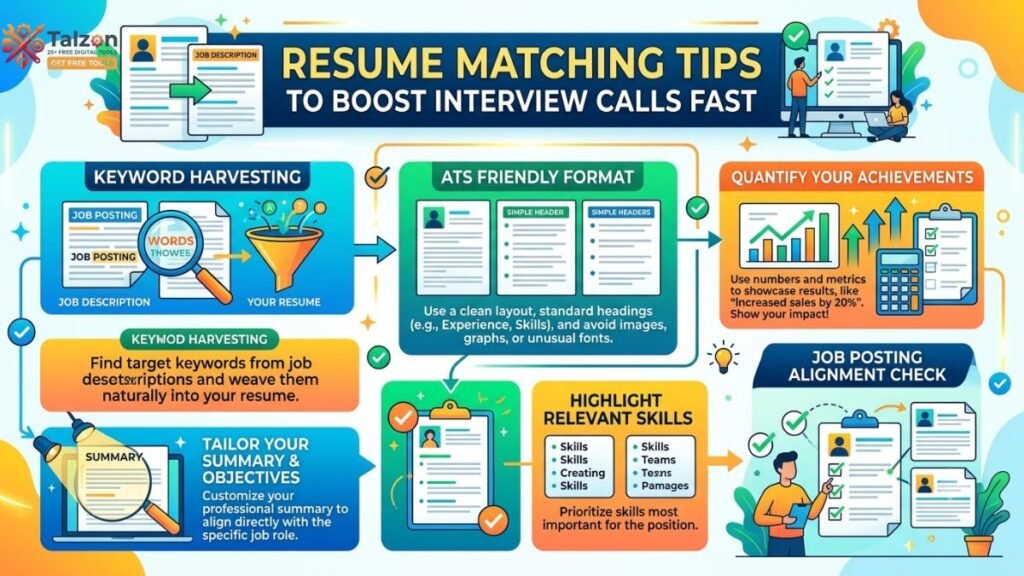
Job seekers often send out dozens of applications and hear nothing back. The problem is not always your experience; it is often how well your resume matches the job description. When you improve resume matching, you make it easier for recruiters and ATS software to see your value quickly.
Why Resume Matching Matters
Most recruiters spend only a few seconds scanning a resume before deciding whether to continue. At the same time, many companies use applicant tracking systems, or ATS, to filter candidates before a human even sees the application. If your resume does not align with the role, it can be overlooked even when you are qualified.
Resume matching helps your application speak the same language as the job posting. It shows the employer that your background, skills, and achievements fit the role they need filled. That simple alignment can make the difference between being ignored and getting called for an interview.
What Resume Matching Really Means
Resume matching is the process of tailoring your resume so it reflects the requirements of a specific job. It is not about stuffing keywords into your document. It is about presenting your experience in a way that connects naturally with what the employer wants.
A strong match includes relevant skills, similar job titles, measurable achievements, and industry-specific language. It also means removing details that distract from your fit for the role. The goal is to make your resume easier to understand, easier to scan, and more persuasive.
Start With the Job Description
The job description is your roadmap. Read it carefully and identify the most important responsibilities, qualifications, and repeated terms. These clues tell you what the employer values most.
Look for:
- Required skills.
- Preferred tools or software.
- Repeated action verbs.
- Industry-specific terminology.
- Experience level and years of experience.
Once you find these patterns, compare them with your own background. Choose the experiences that best match the role and highlight them clearly in your resume. This focused approach improves resume matching and helps your application feel tailored rather than generic.
Use the Right Keywords Naturally
Keywords are essential for ATS and recruiter screening, but they should fit naturally into your content. If the posting says “project management,” “cross-functional collaboration,” and “data analysis,” use those terms where they genuinely apply to your experience.
Do not copy the job description word for word. Instead, mirror the language while staying honest about your background. For example, if you led client campaigns, you might write, “Managed cross-functional teams to deliver marketing campaigns on schedule and within budget.” That sounds natural while still supporting resume matching.
Make Your Summary Work Harder
Your resume summary is one of the most important sections because it appears near the top. It should quickly show that you are a strong fit for the role. Think of it as your professional pitch, not a biography.
A good summary includes:
- Your job title or target role.
- Years of relevant experience.
- Core strengths.
- One or two impressive achievements.
- Keywords relevant to the position.
For example, instead of saying, “Hardworking professional seeking growth opportunities,” try something stronger like, “Results-driven operations specialist with 7 years of experience improving process efficiency, reducing costs, and leading cross-functional teams.” This gives the recruiter a clear reason to keep reading.
Focus on Relevant Experience
Not every job you have ever held needs equal attention. When resume matching, the most relevant experience should be the most visible. Put the strongest and most applicable accomplishments near the top of each role.
If the job emphasizes leadership, highlight projects where you managed people or guided decisions. If it focuses on technical expertise, emphasize tools, systems, and measurable outcomes tied to those skills. The more directly your resume reflects the employer’s needs, the more likely it is to generate interview calls.
Turn Duties Into Achievements
Many resumes fail because they list responsibilities instead of results. Recruiters want to see what you accomplished, not just what you were assigned. Achievement-based bullets are much more persuasive and easier to match to job requirements.
Compare these two examples:
- Responsible for managing sales accounts.
- Managed 40+ enterprise accounts and increased quarterly revenue by 18%.
The second version is stronger because it shows impact. Whenever possible, use numbers, percentages, time savings, cost reductions, or growth metrics. This makes your resume more credible and gives recruiters a clearer picture of your value.
Align Skills With The Role
Your skills section should not be a random list. It should reflect the exact tools and competencies that matter for the job. If the role requires Excel, Salesforce, Python, or SEO, and you have those skills, they should appear prominently.
You can improve resume matching by separating your skills into categories such as:
- Technical skills.
- Tools and platforms.
- Leadership skills.
- Domain knowledge.
This structure makes your resume easier to scan and helps ATS tools identify your qualifications faster. It also gives the recruiter a quick snapshot of whether you match the role.
Customize Every Application
A one-size-fits-all resume usually underperforms. Even if two jobs look similar, each company may value different strengths. Customizing your resume for each application improves your chances significantly.
You do not need to rewrite everything. Small adjustments can make a big difference:
- Change the headline to reflect the target role.
- Reorder bullet points to emphasize relevant wins.
- Add keywords from the posting.
- Remove irrelevant details.
- Adjust the summary for the specific job.
This kind of personalization shows effort and makes your application feel more relevant. It also improves your resume matching score in ATS systems.
Optimize For ATS Without Sounding Robotic
ATS-friendly formatting matters, but readability matters too. A resume should be clean, simple, and easy to parse. Overdesigned layouts, text boxes, and unusual fonts can confuse the system and frustrate recruiters.
Keep your formatting simple:
- Use standard section headings.
- Choose a readable font.
- Avoid graphics and icons.
- Save in a common file format unless instructed otherwise.
- Use consistent date and job title formatting.
The best resumes are both ATS-friendly and human-friendly. They pass the software check while still sounding polished and professional.
Show Career Progression Clearly
Recruiters like to see growth. If your resume shows increasing responsibility, stronger leadership, or measurable improvement over time, it tells a compelling story. That story can help you stand out even when competing against candidates with similar backgrounds.
For example, moving from analyst to senior analyst to team lead demonstrates advancement. Even if your titles did not change much, your resume can still show growth through stronger results, broader scope, and more complex responsibilities. Clear progression strengthens resume matching because it signals readiness for the next role.
Remove Noise From Your Resume
A cluttered resume weakens your message. If a detail does not support your fit for the target role, it may be better left out. This includes outdated skills, unrelated side work, or long descriptions of early-career jobs that no longer matter.
Trim your resume so the most relevant information stands out. A focused resume is easier to read, easier to scan, and more likely to create interview interest. In many cases, less content with stronger alignment performs better than a long document full of unrelated information.
Common Resume Matching Mistakes
Many job seekers lose interview opportunities because of avoidable errors. The most common mistakes include:
- Using the same resume for every job.
- Ignoring the wording in the job description.
- Listing duties instead of achievements.
- Hiding important skills too far down the page.
- Using vague phrases like “team player” without proof.
- Overstuffing keywords in an unnatural way.
Avoiding these mistakes can immediately improve how your resume performs. Even small corrections can raise your chances of getting noticed.
Example Of Better Resume Matching
Imagine you are applying for a digital marketing manager role. The job description asks for campaign strategy, Google Ads, analytics, team leadership, and performance reporting. A weak resume might list broad experience in marketing with generic bullet points.
A stronger resume would highlight:
- Campaign strategy and paid media management.
- Google Ads performance improvements.
- Data-driven reporting and optimization.
- Leadership of marketing teams or external vendors.
- Results such as increased conversions or lower cost per lead.
That version clearly matches the role and makes your application much more relevant. This is the practical power of resume matching.
Final Thoughts
If you want more interview calls, stop treating your resume as a static document. Think of it as a targeted marketing tool that should change based on the job you want. The better your resume matching, the easier it is for recruiters to see that you are a strong fit.
Focus on keywords, achievements, structure, and relevance. Keep the content human, specific, and aligned with the role. When your resume clearly matches the job, your chances of getting interviews rise fast.