
Professional Invoice Guide: Essential Elements to Include
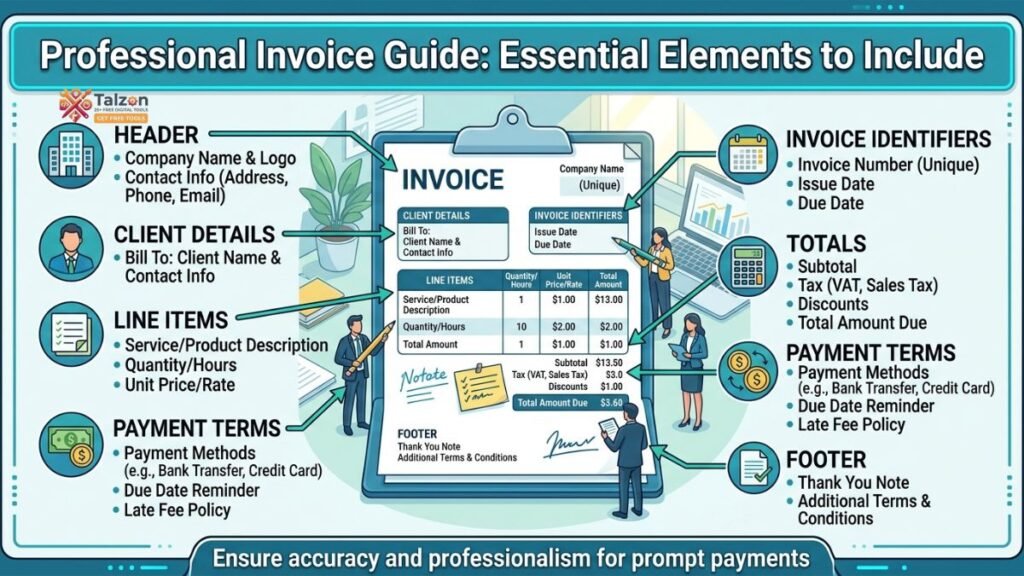
Whether you run a small business, work as a freelancer, or manage a growing company, invoices are an important part of getting paid. A well-prepared invoice tells your customer what they are being charged for, how much they owe, and when payment is expected.
An invoice is more than a simple payment request. It is a financial record, a communication tool, and a reflection of your business. A clear and accurate professional invoice can make your company look trustworthy while reducing confusion, payment delays, and administrative problems.
The good news is that creating an effective invoice does not require complicated design or accounting knowledge. You simply need to include the right information in a clear and organized format. This guide explains the essential elements every invoice should contain and offers practical advice for creating invoices that are easy for customers to understand and pay.
What Is an Invoice?
An invoice is a document a seller sends to a customer after providing products or services. It lists the items purchased, the prices, the total amount due, and the terms for payment.
Invoices are commonly used by freelancers, consultants, agencies, retailers, contractors, and service providers. They may be sent as printed documents, email attachments, PDFs, or electronic payment requests.
An invoice is different from a receipt. An invoice requests payment, while a receipt confirms that payment has already been made. It is also different from an estimate, which gives a customer an expected price before work begins.
A properly prepared invoice creates a record for both parties. The customer can use it for internal approval and bookkeeping, while the business can use it to track sales, income, taxes, and unpaid balances.
Why a Professional Invoice Matters
A professional invoice helps your business communicate clearly. Customers should not have to guess what they are paying for, how the total was calculated, or where to send the money.
A well-designed invoice can help you:
- Get paid more quickly.
- Reduce billing questions.
- Prevent misunderstandings about products or services.
- Maintain accurate financial records.
- Make tax preparation easier.
- Demonstrate that your business is organized.
- Build trust with customers and clients.
Your invoice does not need to be visually impressive. It needs to be accurate, readable, and complete. A simple document with clear headings is often more effective than a colorful layout filled with unnecessary graphics.
1. Business Name and Contact Details
Every invoice should begin with the seller’s information. Include your legal business name or trading name, business address, email address, phone number, and website if applicable.
If you operate as a registered business, you may also need to include your registration number, tax identification number, or other details required by local regulations.
Make sure this information is easy to find. Customers may need it for their accounting records or to verify that the invoice came from the correct supplier.
For a company, include the logo only if it improves recognition without making the invoice harder to read. For a freelancer, your name and professional contact information are usually enough.
2. Customer Information
An invoice should clearly identify the person or organization responsible for payment. Include the customer’s full name, company name, billing address, email address, and phone number when appropriate.
If you are invoicing a large organization, ask whether the invoice needs to include a purchase order number, department name, project code, or accounts payable contact.
Addressing an invoice to the wrong person can delay payment. Before sending it, confirm whether the client wants invoices sent to a project manager, finance department, or a dedicated billing email address.
Accurate customer information also helps you maintain reliable records and makes it easier to identify transactions later.
3. Invoice Number
Each invoice should have a unique invoice number. This number acts as a reference for you and your customer.
You can use a simple sequence such as 001, 002, and 003, or a more descriptive system such as INV-2026-001. If you invoice different departments or business locations, you may include a project or client abbreviation.
The exact format is not important as long as it is consistent and unique. Avoid using the same number for multiple invoices, because this can create confusion in your accounts and make payment tracking difficult.
An invoice number is especially useful when you send reminders. Instead of saying “the invoice from last month,” you can refer to “Invoice INV-2026-014.”
4. Invoice Date
The invoice date shows when the document was issued. This date helps establish the beginning of the payment period and supports accurate bookkeeping.
For example, if your payment terms are fourteen days, the invoice date may be used to calculate the due date. The date can also determine which accounting period includes the sale.
Use a clear format that cannot be misunderstood. Writing “August 26, 2026” is generally clearer than using a numerical format such as “08/26/26,” especially when working with international customers.
5. Payment Due Date
A professional invoice should always state when payment is due. A specific date is better than a general phrase such as “pay soon.”
Common payment terms include:
- Due upon receipt.
- Due within seven days.
- Due within fourteen days.
- Due within thirty days.
- Due on a specific date.
Choose payment terms before starting the project or accepting the order. Your invoice should match the terms in your contract, proposal, or purchase agreement.
If the customer has agreed to pay in installments, list each payment deadline separately. Clear due dates make it easier for both sides to plan cash flow and identify overdue accounts.
6. Description of Products or Services
One of the most important parts of an invoice is the description of what the customer is paying for. Use specific, straightforward language.
For products, include the product name, item number, quantity, unit price, and any applicable discount. For services, describe the work completed, project stage, service period, or agreed deliverable.
Compare these two descriptions:
- “Marketing work — USD 500.”
- “Social media content planning and preparation of 12 promotional posts for August — USD 500.”
The second description gives the customer confidence that the charge is accurate. It also creates a useful record if someone reviews the invoice months later.
Avoid using unexplained abbreviations or internal terms that the customer may not understand.
7. Quantity, Rate, and Subtotal
If you charge by the hour, day, unit, or item, show the calculation clearly. Include the quantity, rate, and resulting subtotal.
For example:
| Description | Quantity | Rate | Subtotal |
|---|---|---|---|
| Website consultation | 3 hours | USD 75 | USD 225 |
For fixed-price projects, you may list one agreed project fee instead. The key is to show how the amount was determined.
Transparent calculations reduce questions and make it easier for customers to approve invoices. They are particularly important when billing for recurring services, multiple products, or reimbursable expenses.
8. Subtotal, Taxes, Discounts, and Fees
Your invoice should show how the final amount was calculated. Start with the subtotal before adding taxes, fees, or other charges.
If you offer a discount, display it as a separate line. This shows the customer that the reduction was intentional rather than an accidental change in price.
If you charge sales tax, value-added tax, or another applicable tax, list the tax rate and amount separately. Depending on your location, you may also need to show your tax registration number.
Additional charges, such as delivery fees, late fees, service charges, or reimbursable expenses, should be clearly identified. Never add a fee that was not previously agreed upon or required by applicable law.
9. Total Amount Due
The total amount due should be easy to locate. Use clear wording such as “Total Due,” “Balance Due,” or “Amount Payable.”
The total should include the subtotal, taxes, discounts, and additional fees. Check the calculation carefully before sending the invoice.
If the customer has already paid a deposit or partial amount, show the payment as a credit and display the remaining balance. This prevents the customer from accidentally paying the full project amount twice.
If you invoice in a foreign currency, write the currency code, such as USD, GBP, EUR, or CAD. Currency symbols alone may be ambiguous for international customers.
10. Payment Methods and Instructions
Customers need clear instructions for paying you. List the payment methods you accept and include all necessary details.
Depending on your business, payment options may include:
- Bank transfer.
- Credit or debit card.
- Online payment platform.
- Digital wallet.
- Check.
- Cash, where appropriate.
For a bank transfer, provide the account name, bank name, account number, routing information, and any international transfer details required. If you use an online payment link, test it before adding it to the invoice.
Explain who is responsible for transaction or transfer fees. If payment instructions are unclear, even a customer who wants to pay promptly may need to contact you first.
11. Payment Terms and Late Payment Policy
Payment instructions explain how to pay, while payment terms explain the conditions surrounding payment. Your invoice may state when payment is due, whether deposits are required, and what happens if payment is late.
For example, you might write:
“Payment is due within fourteen days of the invoice date. Late payments may be subject to a fee as outlined in the service agreement.”
Only include late fees or penalties that are legal in your jurisdiction and agreed upon in advance. Your invoice should support your contract, not introduce surprising conditions after the work has been completed.
Keep the wording polite and professional. Clear terms protect your business without making the customer feel unwelcome.
12. Notes, References, and Supporting Details
A notes section can provide useful context. You may include a thank-you message, project name, purchase order number, service period, delivery information, or instructions for contacting you with billing questions.
For example:
“Thank you for your business. Please reference invoice INV-2026-021 when submitting payment.”
If an invoice covers recurring services, state the period clearly, such as “Website maintenance services for August 2026.” For expense reimbursements, attach receipts when needed.
Do not overload the notes section with long explanations. If the customer needs extensive information, provide it in a separate contract, statement of work, or attachment.
Common Invoice Mistakes to Avoid
Even a complete invoice can cause problems if it contains errors. Before sending yours, check for these common mistakes:
- Incorrect customer name or billing address.
- Missing invoice number.
- Wrong invoice date or due date.
- Vague service descriptions.
- Incorrect calculations.
- Missing tax details.
- Unclear currency.
- Outdated payment instructions.
- Unapproved fees.
- Poor spelling or formatting.
- Failure to save a copy.
Use a checklist or accounting system to review every invoice. A few minutes of careful proofreading can prevent long email exchanges and delayed payments.
How to Make Your Invoice More Effective
Your invoice should be easy to scan. Put the most important details—invoice number, total due, and due date—near the top or in a clearly visible summary area.
Use consistent fonts, spacing, and headings. Keep colors simple and make sure the document remains readable when printed in black and white.
Send invoices promptly. If you wait several weeks after completing the work, the customer may have difficulty matching the charge to the project.
Finally, track your invoices after sending them. Record the date sent, due date, payment status, and follow-up dates. This turns invoicing into a reliable business process rather than a last-minute task.
Final Invoice Checklist
Before sending a professional invoice, confirm that it includes:
- Your business name and contact details.
- The customer’s complete billing information.
- A unique invoice number.
- The invoice date.
- The payment due date.
- A clear description of each product or service.
- Quantities, rates, and subtotals.
- Discounts, taxes, and additional fees.
- The total amount due.
- Currency information.
- Payment methods and instructions.
- Payment terms and late payment conditions.
- Relevant project or purchase order references.
A professional invoice gives customers the information they need to pay confidently and gives your business a dependable financial record. Keep your invoices accurate, clear, and consistent, and they will support both your cash flow and your professional reputation.