
Why Clean Text Formatting Boosts Content Quality
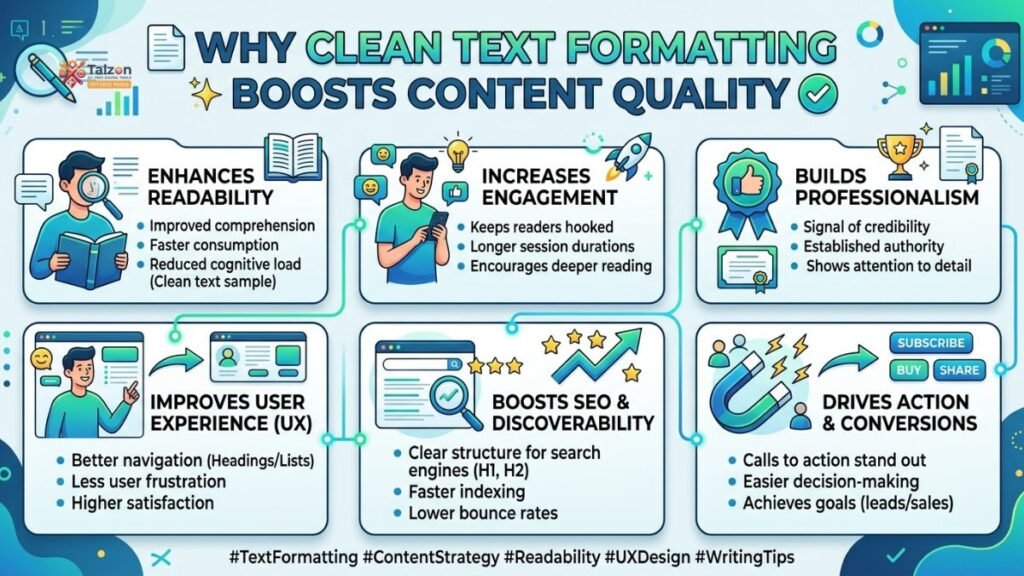
Clean text isn’t just about looking neat—it directly shapes how readers understand, trust, and act on your content. When formatting is clear and consistent, people read more, stay longer, and remember your message better. In 2026, with AI summaries and mobile-first browsing, text formatting has become a core part of content quality.
What “Clean Text” Really Means
Clean text goes beyond spelling and grammar. It refers to how your words are structured and presented on the page. This includes paragraph length, heading hierarchy, spacing, bullet points, and the removal of messy artifacts like repeated spaces or broken line breaks.
In practical terms, clean text means:
- Short, focused paragraphs (2–4 sentences)
- Clear H2 and H3 headings that separate ideas
- Consistent spacing before and after headings
- Bullet or numbered lists for steps and key points
- No hidden HTML tags, pasted formatting glitches, or inconsistent punctuation
When these elements are in place, your content feels polished and professional—even before a single sentence is read.
How Text Formatting Affects Readability
Readers don’t read word-for-word anymore. They scan. Studies show most visitors read only 20–28% of page text, making quick stay-or-leave decisions within about 7 seconds based largely on visual structure.
Clean text formatting supports this scanning behavior by:
- Breaking walls of text into digestible chunks
- Guiding the eye with clear visual hierarchy
- Highlighting key phrases with bold or italics (used sparingly)
- Adding white space to reduce cognitive load
Research indicates that good use of whitespace between paragraphs and margins can increase comprehension by almost 20%. That’s a massive gain for something as simple as spacing.
Why Clean Text Builds Trust and Authority
First impressions matter. A page cluttered with inconsistent fonts, random line breaks, or pasted artifacts looks unprofessional. Readers subconsciously link sloppy formatting to sloppy thinking.
On the other hand, clean text signals:
- Attention to detail
- Respect for the reader’s time
- Editorial rigor and credibility
This is especially important in 2026, where AI-generated content is everywhere. Human-edited, well-formatted articles stand out as more trustworthy and authoritative.
The SEO Benefits of Clean Text Formatting
Google doesn’t have a direct “readability score” ranking factor, but it does track engagement signals like dwell time, bounce rate, and pogo-sticking (when users quickly return to search results). Pages with poor readability drive higher bounce rates and lower dwell time—signals that tell search engines the page didn’t satisfy the query.
Clean text formatting improves SEO indirectly by:
- Keeping readers on the page longer (better dwell time)
- Making content easier for crawlers to parse and categorize
- Increasing the chance of earning featured snippets or AI answers
Headings, lists, and consistent structure help both humans and bots understand your content faster. In an era where AI overviews pull directly from well-structured pages, text formatting is more than cosmetic—it’s strategic.
Common Text Formatting Mistakes That Hurt Quality
Even strong writing can fail if the formatting is off. The most common mistakes include:
- Walls of text: Paragraphs longer than 5–6 lines scare readers away.
- Inconsistent spacing: Uneven gaps between paragraphs or headings create visual noise.
- Missing hierarchy: No clear H2/H3 structure makes content feel flat and confusing.
- Overuse of bold/italics: Highlighting too much dilutes emphasis and looks spammy.
- Pasted artifacts: Hidden line breaks, repeated spaces, or leftover HTML tags from copy-pasting.
Fixing these issues alone can increase content completion rates by over 80%, according to readability research.
Best Practices for Clean Text in 2026
To maximize content quality, follow these text formatting guidelines:
1. Use Short Paragraphs
Aim for 2–4 sentences per paragraph. On mobile, this often translates to 2–4 lines max. Short paragraphs improve scannability and reduce the “wide block of text” effect that happens after copy-pasting.
2. Structure with Clear Headings
Use H2s for main sections and H3s for subsections. Every major idea should have its own heading. This creates a logical flow and helps readers jump to what matters most.
3. Leverage Lists and White Space
Convert dense paragraphs into bullet or numbered lists whenever you’re presenting steps, features, or comparisons. Add white space around headings, images, and quotes to create visual breathing room.
4. Write in Plain Language
Use short, declarative sentences (15–20 words max). Avoid jargon, corporate-speak, and vague hedging like “might” or “some people say.” Clear language paired with clean formatting makes content accessible to wider audiences.
5. Clean Before Publishing
Before hitting publish, strip hidden formatting, normalize whitespace, and fix broken line breaks. Tools like text cleaners can remove invisible problems without changing your meaning, ensuring a polished final draft.
How Clean Text Supports AI and Voice Search
In 2026, generative AI and voice assistants pull answers directly from well-structured content. Bad formatting doesn’t just frustrate readers—it signals to AI that your content lacks value. Clean headers, spacing, and structure influence whether your page appears in AI-generated summaries or voice responses.
For example, a clearly labeled H2 like “Benefits of Clean Text Formatting” is more likely to be extracted as a direct answer than a dense paragraph with no hierarchy. This makes text formatting a key part of AI SEO (also called GEO—Generative Engine Optimization).
Real-World Impact: Engagement and Conversions
Clean text isn’t theoretical. It has measurable business impact:
- Higher dwell time: Readers stay longer when content is easy to scan.
- Lower bounce rates: Clear structure reduces quick exits.
- Better conversions: Professional formatting builds trust, making readers more likely to subscribe, click, or buy.
One study found that fixing just three issues—paragraph length, hidden line breaks, and consistent spacing—made blog posts significantly easier to read and increased completion rates dramatically.
Quick Checklist for Clean Text
Before publishing, ask:
- Are paragraphs 2–4 sentences max?
- Do headings clearly separate each idea?
- Is there consistent spacing around headings and images?
- Are lists used for steps, features, or comparisons?
- Have I removed pasted artifacts and hidden formatting?
If you can answer “yes” to all, your text is clean, readable, and ready to perform.
Final Thoughts
Clean text is a quiet superpower in content creation. It improves readability, builds trust, supports SEO, and future-proofs your content for AI-driven search. In a world where attention is scarce and competition is high, formatting isn’t optional—it’s essential.
By treating text formatting as seriously as your writing, you create content that doesn’t just rank—it resonates.