
Resume Optimization Tips for Competitive Roles
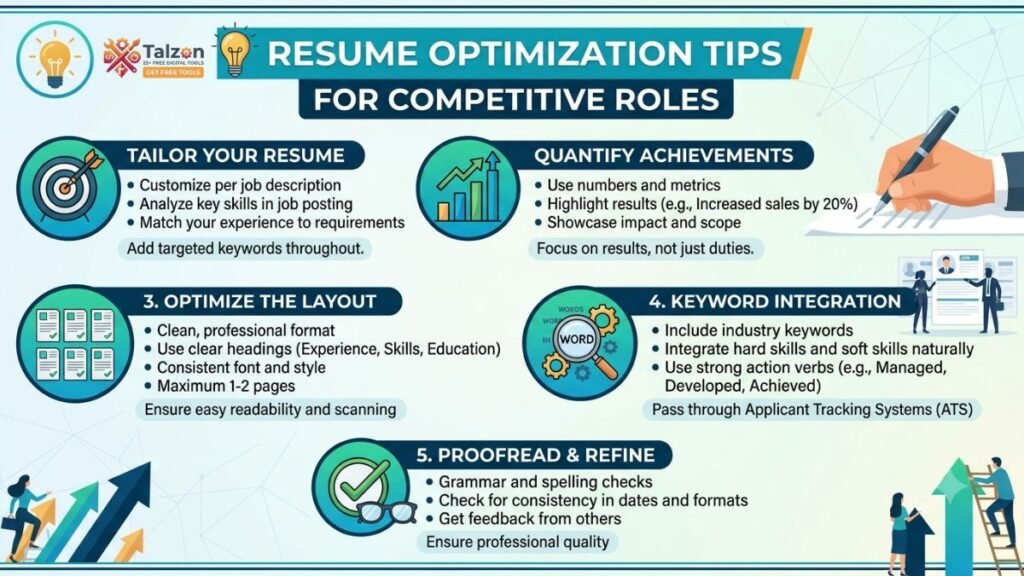
Competitive roles attract dozens, sometimes hundreds, of qualified applicants. That means your resume has to do more than look polished; it has to prove relevance, show results, and match the language employers use in the job posting.
A well-optimized resume also helps recruiters scan your story quickly. If they can understand your fit in seconds, you have a much better chance of moving forward.
Start With the Job Description
The best resume optimization begins before you write a single bullet point. Read the job description carefully, then identify the recurring skills, tools, and responsibilities that seem essential rather than optional.
Use those keywords naturally throughout your resume, especially in your summary, experience section, and skills section. This helps your resume feel aligned with the role without sounding stuffed or robotic.
Tailor Your Resume Every Time
One of the biggest mistakes candidates make is sending the same resume everywhere. In competitive hiring, a generic version usually loses to a tailored one because it does not directly answer what the employer is looking for.
Create a master resume with all your experience, then trim and reshape it for each role. Keep only the achievements and skills that strengthen your case for that specific job.
Lead With Impact
Hiring teams care less about a list of tasks and more about outcomes. Instead of writing “responsible for social media campaigns,” say what changed because of your work, such as growth in engagement, leads, revenue, efficiency, or customer satisfaction.
A simple formula works well: action verb + task + result. For example, “Improved email open rates by 28% by redesigning segmentation and testing subject lines” feels much stronger than a vague duty statement.
Keep Formatting Clean
Even excellent content can be overlooked if the layout is hard to read. Use standard section headings, a simple font, and enough white space so a recruiter can skim your resume without effort.
Avoid tables, text boxes, heavy graphics, and unusual formatting if you want the resume to remain ATS-friendly. Clean formatting improves readability for both software and humans.
Put the Best Material First
Your most relevant experience should appear near the top of the page. In competitive roles, top-loading the resume helps decision-makers see your fit before they lose interest.
That means your summary, key skills, and most relevant achievements should work together as a strong opening. If you are changing careers, emphasize transferable skills early so the reader immediately understands your direction.
Use Numbers Whenever Possible
Quantified achievements make your resume more believable and more memorable. Numbers show scope, scale, and business impact in a way that plain descriptions cannot.
You do not need perfect metrics for every bullet, but you should include them whenever possible. Think in terms of percentages, dollars saved, deadlines improved, growth rates, team size, or volume handled.
Show Relevance, Not Everything
A competitive resume is selective. It should not include every job duty, old project, or unrelated detail; it should highlight what makes you a strong match for this role.
If a skill or project does not support the position you want, cut it or reduce it. This makes your resume sharper and helps your strongest qualifications stand out.
Match Tone and Language
The wording on your resume should feel close to the language used in the posting. If the role asks for “stakeholder communication,” “cross-functional collaboration,” or “campaign optimization,” use those phrases where they honestly apply to your background.
This does not mean copying the job ad word for word. It means speaking the employer’s language so your resume feels familiar, relevant, and intentional.
Keep It Human
Humanized resume optimization is about balance. You want the document to feel professional, but not stiff or generic. Strong resumes sound like a capable person telling a focused career story, not a keyword machine.
To make your writing more human, use clear verbs, specific results, and a confident but natural tone. If a bullet point feels inflated or unnatural when read aloud, simplify it.
Proofread Like It Matters
In a competitive hiring process, small mistakes can create a big impression. Typos, inconsistent tense, weak spacing, or mismatched formatting can make even a great candidate seem careless.
Before you send your resume, read it out loud and check it line by line. Better still, ask someone else to review it with fresh eyes, because even tiny errors can distract from strong content.
A Practical Example
Here is a quick before-and-after example of resume optimization:
- Before: Managed marketing campaigns and worked with different teams.
- After: Led integrated marketing campaigns that increased qualified leads by 34% and reduced cost per acquisition by 19% through closer alignment with sales and product teams.
The second version is better because it is specific, measurable, and clearly tied to business value.
Final Checklist
Before you submit your resume, make sure it does these things well:
- Matches the job description with relevant keywords.
- Highlights measurable achievements instead of duties.
- Uses simple, ATS-friendly formatting.
- Puts the most relevant information first.
- Feels clear, confident, and easy to read.
Conclusion
Effective resume optimization is not about making your resume longer. It is about making every line work harder so your value is obvious, your experience is relevant, and your story is easy to trust.
If you tailor carefully, quantify your impact, and keep the layout clean, you give yourself a real advantage in competitive roles.