
Improve Your Resume ATS Score in 2026 | ATS Resume Checker
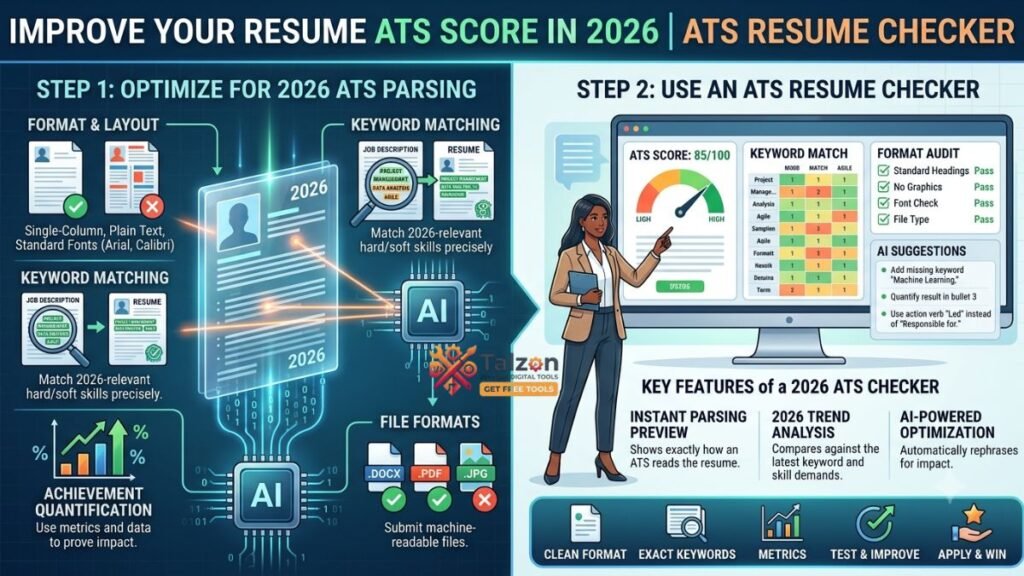
Many job seekers still think a great resume alone is enough. The truth is that most companies use applicant tracking systems to sort applications first, which means your resume has to be readable by software before a human ever sees it.
That does not mean stuffing your resume with keywords or making it look robotic. It means building a resume that matches the job description, uses clear structure, and stays easy to scan. An ATS resume checker helps you do exactly that by showing where your resume may be falling short.
What ATS Looks For
ATS software does not judge your personality or career potential. It scans for signals such as relevant keywords, job titles, skills, dates, and clean formatting that can be parsed correctly.
The best way to think about ATS is simple: if a system cannot read your resume clearly, it cannot match you to the role accurately. That is why structure matters as much as content.
Use the Right Keywords
The most important step is to tailor your resume to each role. Read the job description carefully, identify repeated skills, tools, certifications, and responsibilities, then reflect those terms naturally in your summary, skills, and experience sections.
For example, if a role asks for “project management,” “stakeholder communication,” and “budget tracking,” those phrases should appear where they genuinely fit your background. Do not force keywords into every bullet point; make them sound like real work, not a checklist.
Keep Formatting Simple
A clean layout is one of the easiest ways to improve ATS performance. Single-column resumes, standard section headings, simple fonts, and clear bullet points are usually safer than graphics, tables, text boxes, or decorative designs.
ATS tools can struggle when information is hidden in headers, footers, images, or complex columns. If your resume looks elegant but parses badly, you are losing points before the recruiter even opens the file.
Match the Job Description
One resume should not be sent to every job. The stronger approach is to adjust your content for each application so the resume mirrors the language of the posting as closely as possible.
Focus first on the job title, then the core skills, then the measurable achievements that support the role. This is where an ATS resume checker becomes valuable, because it can show which words are missing and whether your resume is aligned with the specific posting.
Build a Strong Skills Section
Your skills section should not be a random list of software and buzzwords. It should highlight the tools, platforms, and abilities that directly support the job you want.
A strong skills section often includes hard skills, relevant systems, and role-specific keywords in a format that is easy for ATS to read. If the job description mentions Salesforce, SQL, and customer retention, make sure your resume reflects those skills accurately and naturally.
Write Better Experience Bullets
Your experience section should do more than describe duties. It should prove value with action, context, and results.
A weak bullet says what you did. A stronger bullet says what you achieved and, when possible, includes numbers. For example: “Managed email campaigns” is weaker than “Managed email campaigns that increased click-through rates by 18% in six months.” Clear achievement language gives ATS more relevant context and gives recruiters a reason to keep reading.
Use Acronyms Smartly
If your industry uses acronyms, spell them out at least once. This helps both ATS matching and human understanding, especially if different employers use different terminology.
For instance, write “Customer Relationship Management (CRM)” the first time, then use CRM later if needed. This simple move improves keyword coverage without making your resume feel repetitive.
Choose the Right File Type
The best file format is usually the one the employer asks for, often PDF or DOCX. When in doubt, follow the instructions exactly, because some systems work better with one format than another.
Also, avoid image-based resumes or files that require extra interpretation. The easier the text is to extract, the better your odds of a clean ATS parse.
Check Your Resume Before Applying
This is where an ATS resume checker can save you time and rejections. Upload your resume, compare it against the job description, and look for missing keywords, layout issues, and weak sections before you hit submit.
A good workflow is:
- Paste the job description into the checker.
- Review missing or underused keywords.
- Fix the layout first.
- Improve the summary, skills, and experience sections.
- Run the scan again after edits.
Common Mistakes to Avoid
Some resume mistakes hurt ATS performance more than people realize. Over-designing the layout, using vague job titles, repeating keywords unnaturally, and hiding important details in headers or graphics can all reduce readability.
Another common issue is using a generic resume for every job. Even if your experience is strong, a poor match between your wording and the posting can lower your resume’s relevance score.
Final Thoughts
Improving your resume ATS score in 2026 is not about tricking software. It is about making your resume clear, relevant, and easy to parse while still sounding human.
If you use an ATS resume checker, tailor your resume to each job, simplify formatting, and focus on real keywords from the posting, you will give yourself a much better chance of reaching a recruiter. That small extra effort can make the difference between being filtered out and getting called in.